The Evolution Of (Progressive) Organizational Strategy

For months—maybe even years—we have talked about an online Corporate Rebels Academy. But, with our busy schedules and travels, we always found an excuse to not start this journey. Then the corona crisis changed everything. We cancelled most of our trips, cleared our agendas for months to come, and found ourselves with time to work on things that were overdue. This included our very own online Corporate Rebels Academy.
The focus of our first online course will be the design of progressive organizations, especially large ones that organize without middle-managers (it’s no coincidence this is also the topic of my PhD research). For 5 years now, we have visited many progressive organizations around the globe. We studied them in depth and found that most show a remarkably different approach to organizing their businesses, by design.
Most depart radically from the traditional hierarchical and bureaucratic way of organizing (a la machine organization) that dominates most modern-day businesses. Instead, this select group organizes in much more human-centric ways – even at large scale. Think of Buurtzorg in The Netherlands, Haier in China, NER Group in Spain, Nearsoft in Mexico and Centigo in Sweden.
Although these organizations find their unique ways to organize, there are parallels to be drawn between them. Notably, and apart from being radically different to the norms in their industries, this group is incredibly successful at running their organizations in a humane manner.

An advanced level course
Our online course will be for an advanced level. It will teach you how to progressively design, organize and run your organization like this group does. It will teach you how to apply the winning strategies of these organizations to your own.
We are working on the content right now. It will include case studies of some of the most unique pioneering organizations of our bucket list. These will go much deeper than you can read in our blogs and our book (and other books).
I won’t go into the complete scope, scale and shape of the course here. That will be in another post, as we are still working on some elements. (But you can check the video below for more info)
The evolution of strategy work
In this post I would like to share some of the content I’ve already written, and invite your feedback. This part covers, briefly, the evolution of strategy in traditional organizations, and a summary of how it is done differently in progressive organizations. Let’s start with the overview of strategy evolution over recent decades.
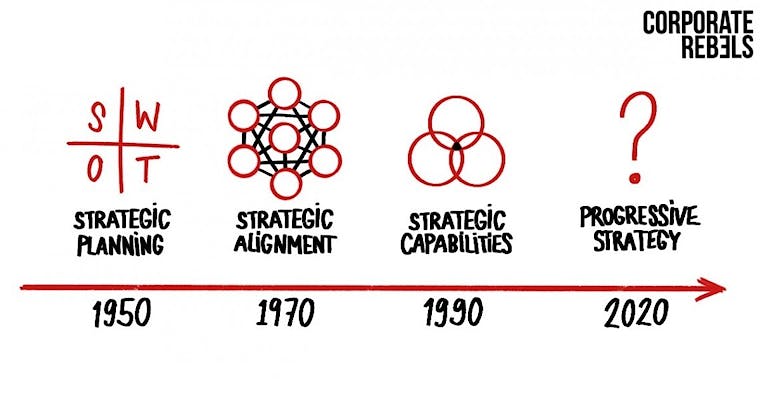
Strategic planning
Following the industrial revolution, the traditional, top-down, hierarchical model became fashionable. Strategic work was the job of a dedicated group at the top of the pyramid. In early days, this group of seniors focused on serving the internal needs of the organization, with little regard for external factors like competitors, or even customers. It became fashionable for leaders to go to ‘off-site meetings’ and spend days planning the future of their organization.
Once the strategic plan was designed (often using tools like SWOT analysis), the leaders would agree upfront on a long-term timeline to implement the strategy. These one, three, or five-year horizons became the holy strategic pathway for the organization. It was broken down into short-term objectives and performance targets. These were cascaded down the hierarchy. All this was done without much connection to the real-time or potentially-changing business environment.
Strategic alignment
The strategic planning process was, traditionally, not aligned with the members who would have to implement it. This began to change in the 1970s with the introduction of classic strategy frameworks (like Galbraith’s star model and McKinsey’s 7S framework). These were checklists of levers to be synched like internal structures, systems and culture with the strategy.
The frameworks were based on the theory that, for an organization to perform well, all these elements needed to be vertically aligned and mutually reinforcing. Thus, strategic work aimed to vertically align the entire organization around the structures, systems and culture needed to deliver the strategy.
However, these alignment decisions were mostly the judgement of a few key people at the top of the pyramid. Most in the organization were not aware of the process or simply did not understand it.
Strategic capabilities
These strategic alignment processes were done without much consideration of factors that lay outside of the organization. This changed in the 1990s, mainly due to the work of management gurus C.K. Prahalad and Gary Hamel. They redefined strategy as the so-called ‘core competences’ or ‘core capabilities’ organizations needed to deliver value to customers.
This was based on the theory that a specific set of skills and resources, difficult to imitate by competitors, would enable an organization to access a variety of markets, and distinguish themselves in these marketplaces. Strategic capability theory argued that to succeed in the global marketplace it was more important to build core capabilities rather than to vertically align the organization using classic strategy frameworks.
Thus, strategy work, still mostly done by a few at the top of the pyramid, evolved into something that aimed to align the entire organization around a few key capabilities.
Strategy in progressive organizations
Progressive firms do not believe strategic planning, strategic alignment, nor strategic capabilities are the right tools for the environments they operate in.
They believe all members of an organization need to be able to embrace change as soon as it arrives. This is based on the belief that autonomous front-line members are best-placed to anticipate customer needs, and should have access to digital platforms to share, develop and execute best strategies with each other.
That is why progressive organizations do not base long-term strategy on trying to predict the future, or other fortune-telling exercises. They do not preset strategy in clearly laid-out annual plans. Instead, to build their desired strategy agility, they establish long-term, guiding purpose and principles for their entire organization, and let strategy emerge organically from it.
As such, strategy and execution become one, and occur simultaneously in rapid iterations.
Your feedback
What do you think? Are there some key developments in the evolution of strategy missing? Is there something crucial I completely missed?


